Chaos In Circuits And Systems
With a combination of overview, tutorial and technical articles, this book describes state-of-the-art research on significant problems in the field of chaos in circuits and systems.
 TABLE OF CONTENTS
 Noise performance is the most important characteristic of a modulation scheme and receiver configuration. All of the correlator-based chaotic modulation techniques to be discussed in this chapter can be considered under the unifying umbrella of the basis function approach. Here, we evaluate their noise performance, assuming the receiver block diagram shown in Fig. 22.7, where r m( t) = S m( t) + n( t) and 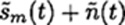 denote the noisy received signal before and after filtering, respectively. Note that the channel (selection) filter, which is an ideal bandpass filter with a total RF bandwidth of 2 B, is included explicitly in this figure.
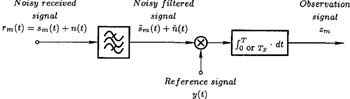
This model can be used to characterize the performance of noncoherent, differentially coherent, and coherent correlation receivers. The difference between these schemes is primarily due to the way in which the reference signal y( t) is generated at the receiver. The synchronization time T S differs from zero if the reference signal is recovered by synchronization at the beginning of each symbol.
In the following sections, we use this model to develop performance limits for CSK with one and two basis functions.