Chemistry and Technology of Polyols for Polyurethanes

The oligo-polyols for elastic polyurethanes (PU) are characterised by a high molecular weight (MW), usually situated in the range of 2000-6500 daltons, and by a low functionality, of around 2-3 hydroxyl groups/mol. The high elasticity is given firstly by the high mobility of the oligo-polyol chains, which permits free rotation around the bonds of the main chain and, as general rule, these polymers have a low value for the glass transition temperature (T g) in the range of 50 C to 86 C. At room temperature, the oligo-polyols for elastic PU are situated in the highly elastic domain and conserve this important characteristic at lower temperatures (of course at negative temperatures higher than T g). It is clear that the high elasticity of the resulting polyurethanes is given by the high MW and high mobility oligo-polyol segment and due to the low crosslink density, as a consequence of the low functionality of the oligo-polyols.
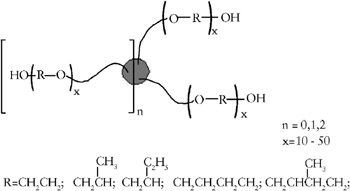
The polyether polyols for elastic polyurethanes are low MW polymers, with terminal hydroxyl groups, characterised by the following general repeating unit (see Figure 4.1).
Because the functionality of an oligo-polyol for elastic polyurethane is 2-3 hydroxyl groups/mol, the general formula shown in Figure 4.1 becomes the formula shown in Figure 4.2.
Polyalkylene oxide polyether polyols are the most important group of polyols for PU, representing around 80% of the total oligo-polyols production. The general formula of a polyalkylene oxide polyether polyol is presented...