Overview
Aminic polyols are low molecular weight adducts of propylene oxide (PO) [and/or ethylene oxide; (EO)] made from aliphatic or aromatic polyamines such as: ethylenediamine (EDA), diethylene triamine (DETA) [1, 2], ortho-toluene diamine (o-TDA) [3, 4] or diphenylmethanediamine (MDA) [2, 5, 6]. Because these starters are liquid at room temperature (EDA, DETA) or low melting point solids (o-TDA, MDA), they are alkoxylated in the absence of solvents.
The general reaction is:
| (14.1) | 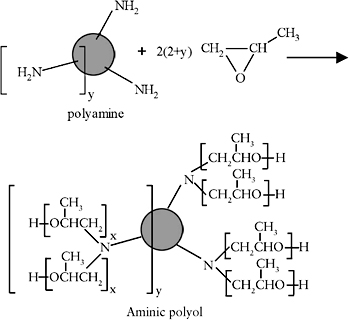 |
As a general rule, all the aminic polyols are much more reactive in the reaction with the aromatic isocyanates than the polyether polyols for rigid polyurethane (PU) foams initiated by polyolic starters, due to the presence in their structure of the tertiary amino nitrogens with a strong catalytic effect in the reaction between -NCO groups and hydroxyl groups [7-9].
The reaction of primary or secondary amines with an alkylene oxide (PO or EO), does not take place in perfect anhydrous conditions. By the addition of small quantities of a compound having hydroxyl groups, such as: water, alcohols, phenols, organic acids and so on, the reaction is initiated immediately and takes place easily. As explained before, the weak hydrogen bonds formed between the hydrogen atoms of hydroxyl groups and the oxygen atom of the oxiranic cycle activate the epoxydic ring and the weak nucleophilic nitrogen atom of the amines attacks the carbon atom of the oxiranic cycle (see reaction 13.15).
During the alkoxylation of the amino groups, as shown in reaction 14.1, hydroxyl groups are formed, which...

 TABLE OF CONTENTS