Chemistry and Technology of Polyols for Polyurethanes
The freshly prepared, flexible PU foams, using tertiary amines as foaming catalysts, are well known to have an unpleasant odour, characteristic of amines. The staining of vinylic films or degradation of polycarbonate sheets is produced as a consequence of the aminic catalyst emission from PU foams. This problem is serious, especially in environments where there are elevated temperatures for long periods of time, for example in an automobile interior. These problems need a reduction of migratory amine catalyst emissions.
To solve these problems, polyols with self-catalytic activity and of course with low volatility were created, using polyamines as starters [148-152]. These polyols, with an intrinsic catalytic activity, are chemically incorporated in the PU structure. As an immediate consequence, the quantity of amines needed as the catalyst is reduced considerably and, of course, the amine emissions are also considerably diminished.
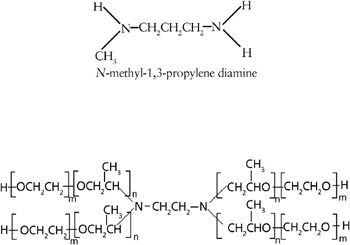
One of the first polyether polyols of this category was based on ethylenediamine (Figure 4.39). This polyol with a MW of around 7000 daltons, PO-EO copolyether (13-15% EO) with poly[EO] as terminal block, was used successfully for making cold cure high resilience moulding flexible PU foams. The self-catalytic effect of the polyol was not so important, but some beneficial effects emerge: a very attractive and uniform foam surface and a nonshrinking foam, with a high percentage of open cells.