Chemistry and Technology of Polyols for Polyurethanes

The very low glass transition temperature (T g) of polysiloxane chains (T g = 123 C) is a very attractive property for using these kinds of polymeric chains to build an oligo-polyol structure with terminal hydroxyl groups [1]. The resulting structure called a polysiloxane polyol gives, after reaction with diisocyanates, polyurethane (PU) elastomers which conserve their high elasticity at very low temperatures [1].
The synthesis of some experimental siloxane polyols is based on several reactions developed in two steps:
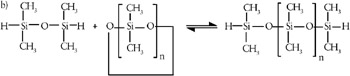
Step I: synthesis of a polysiloxane chain of molecular weight (MW) of 1000-3000 daltons, having terminal -Si-H bonds, by using classic reactions (reactions 11.1 and 11.2) [2-6]. These kinds of polysiloxanes with terminal -Si-H bonds are available commercially.
| (11.1) | ![]() |
| (11.2) | ![]() |
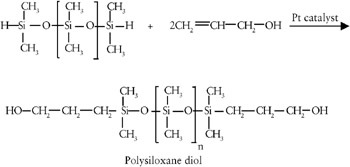
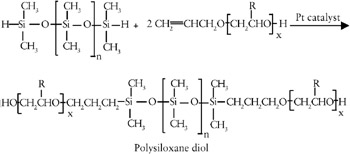
Step II: The addition of the -SiH group to a compound having a double bond and a hydroxyl group (allyl alcohol or allyl alcohol based polyethers). The reaction is catalysed by platinum, palladium or rhodium catalysts (for example H 2PtCl 6, platinum complexes or even solid platinum supported catalysts). Hydrolysis resistant -Si-C- bonds (reactions 11.3 and 11.4.) are formed.
| (11.3) | ![]() |
| (11.4) | ![]() |
Reaction 11.4 is used to decrease the unsaturation of polyether polyols simultaneously with the functionality increase. Thus, by introducing a polyether polyol with high unsaturation (0.07-0.09 mequiv/g), a low molecular weight polysiloxane compound, having 2-3 Si-H groups/mol, together with a platinum catalyst, the polyether monol present in the polyether (in fact allyl ether based polyethers) is added to the polysiloxane compound and the monol...