4.2 Anionic Polymerisation of Alkylene Oxides Catalysed by Phosphazenium Compounds
Phosphazenium compounds are a new class of catalyst that are extremely efficient in the anionic polymerisation of PO and EO, initiated by hydroxyl groups [34-38, 144-146].
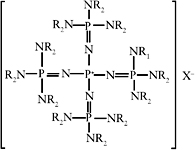
The general formula of a phosphazenium alkoxylation catalyst is:
The main characteristics of these phosphazenium compounds are a large volume of organic cations, excellent thermal and chemical stability of the cation and, as an immediate consequence of the large volume, a high degree of dissociation (practically 100%) of these salts in organic media. For good catalytic activity, the anion X - is preferably an alcoholate (RO -) or hydroxide (HO-). But the most important characteristic of phosphazenium catalysts is the very high basicity of these compounds (organic superbases), which makes them practically comparable with alkali hydroxides.
To explain the catalytic mechanism of the alkylene oxide polymerisation with phosphazenium compounds, several considerations concerning the peralkylated polyamino-phosphazenes should be made.
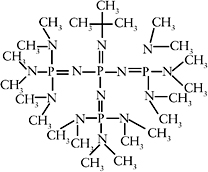
The reagent of the year in 1992 was one of the strongest organic bases, called the Schwesinger reagent [147]:
The question is: why are these phosphazene compounds very strong bases that are comparable with alkali hydroxides?
The answer is: that the high basicity is a consequence of an organic cation of great stability obtained by a special kind of conjugation called an isovalent conjugation. In this kind of conjugation the positive charge is distributed on a high number of atoms:
| (4.26) | 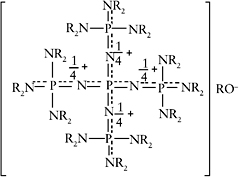 |
This special kind of conjugation increases considerably the stability of the...

 TABLE OF CONTENTS