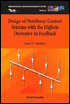
Design Of Nonlinear Control Systems With The Highest Derivative In Feedback, Volume 16
Chapter 1: Regularly and Singularly Perturbed Systems

The main purpose of this chapter is to briefly explain some preliminary mathematical results concerning the properties and analysis of perturbed differential equations. These are used throughout the book as background for a technique of approximate analysis and design of nonlinear control systems. In particular, the main notions of two-time analysis, as well as the conditions for the stability of regularly and singularly perturbed differential equations, are introduced. Quantitative criteria for degree of time-scale separation between fast and slow motions are considered.

1.1 Regularly Perturbed Systems

1.1.1 Nonlinear Nominal System

Let us consider an autonomous (time-invariant) dynamical system given by

(1.1)

where

  • X is the state of the system (1.1), X ? ? n, X = { x 1, x 2, ..., x n} T;

  • f and g are continuous functions of X on ? X;

  • ? X is an open bounded subset of ? n;

  • ? is a positive small parameter.

Taking ? = 0 in (1.1) we obtain the system

(1.2)

which is called the nominal system. The system (1.1) is called a perturbation or perturbed system of the nominal system (1.2).

First, let us make some assumptions regarding the properties of the nominal system.

Let 0 ? ? X ? ? n and let X = 0 be an equilibrium point of (1.2), i.e., f( X) X = 0 = 0. Let us assume that a Lyapunov...

UNLIMITED FREE
ACCESS
TO THE WORLD'S BEST IDEAS

SUBMIT
Already a GlobalSpec user? Log in.

This is embarrasing...

An error occurred while processing the form. Please try again in a few minutes.

Customize Your GlobalSpec Experience

Category: Industrial Valves
Finish!
Privacy Policy

This is embarrasing...

An error occurred while processing the form. Please try again in a few minutes.