Design Of Nonlinear Control Systems With The Highest Derivative In Feedback, Volume 16
7.3: Insensitivity Condition for MIMO Control System

7.3 Insensitivity Condition for MIMO Control System

7.3.1 Desired Dynamics Equations

From (7.13) and (7.17), it follows that for i = 1, , p the relative highest derivative depends explicitly on the control vector u( t). Therefore an arbitrary behavior of the relative highest derivative vector y * ( t) may be provided by appropriate selection of the control function u( t). Let us construct the reference model of the desired behavior of the relative highest derivative of y i( t) for each i = 1, , p in the form of the stable differential equation

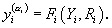
(7.23)

This is called the desired dynamics equation of y i( t), where


Equation (7.23) is the counterpart of (4.31), and can be selected in the form of the linear differential equation (2.8). The parameters of (7.23) for each ith output component are assigned in accordance with the time-domain specifications on the desired output behavior of y i( t) and the requirement

(7.24)

where e i = r i - y i and i = 1, , p. Hence we have y i = r i at the equilibrium of (7.23) for r i = const.

As a result, we have the system of stable differential equations

(7.25)

composed of the equations (7.23), where F = { F 1, F 2,

UNLIMITED FREE
ACCESS
TO THE WORLD'S BEST IDEAS

SUBMIT
Already a GlobalSpec user? Log in.

This is embarrasing...

An error occurred while processing the form. Please try again in a few minutes.

Customize Your GlobalSpec Experience

Category: Industrial Valves
Finish!
Privacy Policy

This is embarrasing...

An error occurred while processing the form. Please try again in a few minutes.