Design Of Nonlinear Control Systems With The Highest Derivative In Feedback, Volume 16
Prior to the introduction of any specific design technique, it is appropriate to discuss performance criteria for control systems. These are usually imposed via the inclusion of some reference model in the controller, either explicitly or implicitly. We therefore use this chapter to highlight some basic correlations between the time-domain specifications of the control system output response and the pole-zero locations of the transfer function or, alternatively, the parameters of the linear differential equation.
In particular, we discuss basic step response parameters and the problem of output regulation for nonlinear time-varying control systems. We present a model of desired output behavior in the form of a differential equation, the parameters of which are based on required step response parameters (overshoot, settling time). Finally, we discuss the key role played by zeroes in the transfer function of the reference model with regard to the attainment of accuracy in the regulation problem.
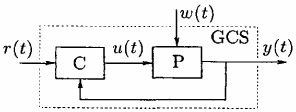
A block diagram of a general control system (GCS) appears in Fig. 2.1, where
| P | is a plant, |
| C | is a controller, |
| y | is a measurable output (or controlled variable), |
| u | is a control (manipulated variable) of the plant, |
| r | is a reference input, |
| w | incorporates external disturbances or variable parameters unavailable for measurement. |
Our goal is to design a control system subject to the condition that
| (2.1) | |
where e( t) = r( t) - y( t) is the error of...