Design Of Nonlinear Control Systems With The Highest Derivative In Feedback, Volume 16
7.4: Internal Stability

7.4 Internal Stability

7.4.1 Boundedness of NID-Control Function

Let us consider the behavior of the control function u( t) and the state vector X( t) of the system (7.1) (7.2), given that the desired reference input-controlled output map assigned by (7.25) is satisfied.

Assume henceforth that equidimensional input and output vectors of the system (7.1) (7.2) are considered, i.e., that m = p.

From (7.28) it follows that the function

(7.29)

uniquely satisfies (7.27) and is the solution of the nonlinear inverse dynamics. By substituting (7.29) into the state equation (7.1), we obtain

(7.30)

The system (7.30) describes the behavior of the state vector X( t) of the system (7.1) (7.2), given that the desired output behavior assigned by (7.25) is fulfilled.

Remark 7.4

It is easy to see that (7.29) (7.30) and the inverse system equations (7.21) (7.22) are the same. So, the boundedness of the NID-control function (7.29) corresponds to bounded-input-bounded-output (BIBO) stability of the inverse system (7.21) (7.22). Related remarks can be found in [Silverman (1969) ; Porter (1970) ; Fomin et al. (1981) ].

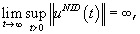
If the nonlinear inverse dynamics solution u NID( t) of (7.29) is an unbounded function, i.e.,


then the desired output behavior assigned by the reference model (7.25)


is unrealizable in the system (7.1) (7.2) where t ? [ t 0, ?). This is because the increase in the control function u NID( t) leads inevitably to saturation of the control variables in...

UNLIMITED FREE
ACCESS
TO THE WORLD'S BEST IDEAS

SUBMIT
Already a GlobalSpec user? Log in.

This is embarrasing...

An error occurred while processing the form. Please try again in a few minutes.

Customize Your GlobalSpec Experience

Category: Flow Controllers
Finish!
Privacy Policy

This is embarrasing...

An error occurred while processing the form. Please try again in a few minutes.