Direct Nuclear Reactions

The nature of the experimental observation is the following: A beam of particles, such as protons, deuterons, alpha particles, or heavier nuclei (referred to as heavy ions), is accelerated to a desired energy and then deflected so as to strike a target of known isotopic composition. The energy and scattering angle of some of the products of the collision are measured. For example, in a reaction initiated by protons, the proton itself will sometimes emerge, deflected in angle but having the same energy in the center-of-mass system. This is elastic scattering, and (as we shall discuss) the measurement of this cross section is important because its analysis yields the parameters of the optical potential.
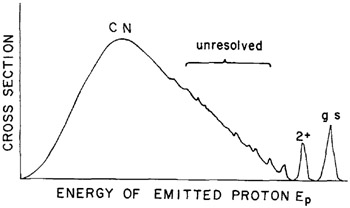
Sometimes the proton will excite the target nucleus from its ground to some higher-energy state, thus losing some energy and at the same time being deflected in angle. This is an inelastic event. The cross section for such an event yields information on the spin and parity of the nuclear transition and, in a way that will be described more fully, is sensitive to the wave functions of the nucleons that are excited. When the detector angle is fixed and the energy of the scattered protons plotted, the result is typically a spectrum such as that schematically illustrated in Fig. 1.1.
One observes discrete groups...