C. ZERO-RANGE APPROXIMATION
To render the integral defining the amplitude  more tractable, we now consider the approximation
| (7.22) | 
|
There are several possible ways of estimating the magnitude of D 0. If a Hulthen wave function is employed as the deuteron wave function, one finds
| (7.23) | 
|
Alternatively, it can be evaluated using effective range theory; the result is the same (Austern, 1970).
We are assuming that the dueteron exists only in the S state. There is a small D-state component, and its effects have been investigated by several authors (Johnson and Santos, 1967 and Delic and Robson, 1970). They are small but may be more important for transfers involving high angular momentum ? than for low values.
With reference to the coordinates in (2.5) one can see that the effect of the zero-range approximation is
| (7.24) | 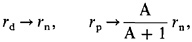
|
so that B becomes
| (7.25) | 
|
which is now a three-dimensional integral. The two angle integrals can be done very easily be introducing the partial-wave expansions for the distorted waves (4.7) and (5.14) and making use of well-known results of angular momentum algebra (see A11), with the result
| (7.26) | 
|
where
| (7.27) | 
|
To summarize, the zero-range approximation has allowed the reduction to a single radial integral. That integral involves the bound state radial function and the radial functions for the distorted waves that are solutions to the optical-model wave equation (4.6) and (4.7). That involves, as discussed, the complex optical potentials U p and U d. Except for square-well potentials,...

 TABLE OF CONTENTS