Direct Nuclear Reactions

F. SPECTROSCOPIC FACTORS FOR ONE-NUCLEON TRANSFER

F. SPECTROSCOPIC FACTORS FOR ONE-NUCLEON TRANSFER

A quantity of great importance in one-particle transfer reactions is the spectroscopic factor, which is the square of the parentage amplitude ? defined in Eqs. (7.8), (7.13), and (7.14). The reason for its importance is evidently that it measures the degree to which a state populated in a transfer reaction is a single-particle state. In the ideal shell model, the low-lying states of an odd nucleus would be pure single-particle shell model states. This situation is realized to a high degree near doubly magic nuclei such as 208Pb. The addition of one neutron or proton would form 209Pb and 209Bi, respectively, whose lowest states are good examples of nearly pure single-particle states. The removal of a neutron or proton likewise produces nearly pure hole states.However, in nuclei removed from such a special situation, the single-particle nature of the ideal shell-model state is spread over several, or even many, nuclear states. This is already implied by our parentage expansion (7.8), in which many states of the nucleus (A+1) can share a fraction of the single-particle orbital labeled by n ?j.

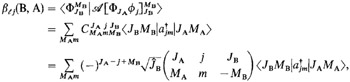
Expression (7.14) for the spectroscopic factor, written in terms of wave functions, can also be written as a reduced matrix element of a particle creation operator. This provides a concise statement and is particularly useful in the quasi-particle picture for treating the pairing interaction in nuclei. Thus, from its definition (7.14), we may write

(7.28)

where denotes a creation...

UNLIMITED FREE
ACCESS
TO THE WORLD'S BEST IDEAS

SUBMIT
Already a GlobalSpec user? Log in.

This is embarrasing...

An error occurred while processing the form. Please try again in a few minutes.

Customize Your GlobalSpec Experience

Category: Radiation Detectors
Finish!
Privacy Policy

This is embarrasing...

An error occurred while processing the form. Please try again in a few minutes.