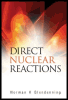
Direct Nuclear Reactions

E. IMPROVEMENTS WITHIN THE FRAMEWORK OF THE DWBA

E. IMPROVEMENTS WITHIN THE FRAMEWORK OF THE DWBA

The basic expression for the T matrix with which a DWBA calculation begins is given by Eq. (7.1). Even this expression is not trivial to compute. Various assumptions, depending on the particular reaction, are often made in evaluating the DWBA amplitude. These are in addition to the basic assumptions discussed in Chapter 5, which underly this amplitude. For example, in the application discussed in this chapter, it was assumed that

  1. the optical potential is local,

  2. there is an average cancellation of the optical potential against the proton-nucleus interaction,

  3. V pn is the interaction responsible for the reaction,

  4. V pn is of zero range, and

  5. the neutron is removed from a shell model state of the nucleus.

The last point may not appear to be an assumption because, in principle, the parentage expansion (7.8) exists. In practice it is not known (see Philpott et al., 1968). To know it would be tantamount to having the solution of the (A+1)-body problem. However, in regions of closed shells one feels confident that it is dominated by a few terms that can be approximated by shell-model wave functions, and that the single-particle wave functions are approximately eigenstates of a potential well.

A review of how some shortcomings have been handled can be found in the work of Glendenning (1975b) and can be used as a guide to the original literature on the subject. The finite range of the interaction is the...

UNLIMITED FREE
ACCESS
TO THE WORLD'S BEST IDEAS

SUBMIT
Already a GlobalSpec user? Log in.

This is embarrasing...

An error occurred while processing the form. Please try again in a few minutes.

Customize Your GlobalSpec Experience

Category: Diodes
Finish!
Privacy Policy

This is embarrasing...

An error occurred while processing the form. Please try again in a few minutes.