Direct Nuclear Reactions

D. EXAMPLES

D. EXAMPLES

Before the theory can be applied to an analysis of data, it is necessary to obtain satisfactory optical-model parameters for both initial and final channels of the reaction. They are chosen, as discussed, to reproduce the elastic scattering at the same energies as the reaction under consideration or, if such elastic data is not available, then under the approximate conditions of the reaction. Any deviation at this point introduces an inaccuracy into the subsequent analysis.

The analysis of the


reaction affords a good example. In a case such as this, where the target is an even nucleus, then only one value of ? and j is consistent with conservation of angular momentum and parity. In a shell-model interpretation of the nucleus, these define the shell-model state into which the particle is stripped. There may be other components in the wave function. For example,


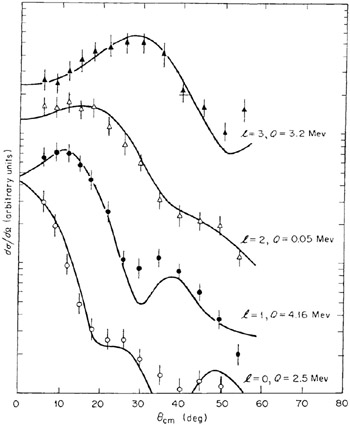
is a possible wave function. The reaction can, to the order we consider, populate only the first component and thus provide a measure of or the spectroscopic factor as it is frequently called. Figure 7.1 shows four transitions of two different shell-model states in 57Fe. Both the data and the theory illustrate the dependence of the angular distribution on ?. In particular, the qualitative rule obtained in Chapter 2 from the consideration of angular momentum conservation and also the expectations based on the plane wave theory are born out.


Fig. 7.1: The DWBA stripping theory corresponding to neutron transfer into...

UNLIMITED FREE
ACCESS
TO THE WORLD'S BEST IDEAS

SUBMIT
Already a GlobalSpec user? Log in.

This is embarrasing...

An error occurred while processing the form. Please try again in a few minutes.

Customize Your GlobalSpec Experience

Category: Environmental Testing and Analysis Services
Finish!
Privacy Policy

This is embarrasing...

An error occurred while processing the form. Please try again in a few minutes.