Direct Nuclear Reactions

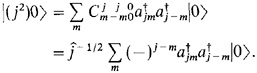
In regions of the periodic table that are removed by more than several nucleons from closed shells, the ordinary shell model becomes very cumbersome. Nuclear wave functions would have to be described in terms of a number of valence particles occupying a number of shell-model states. The number of configurations having the same spin becomes very large for low spins, such as are found near the ground state of even nuclei. The conventional shell model would therefore involve diagonalizations of large matrices. Although this can be done, for many purposes, considerable physical insight is gained, as well as a great simplification, by considering an alternative solution to the interacting shell-model problem. This involves the recognition of the prominent part played by the large pair interaction of an angular momentum zero pair ( jj)0. Such a state is a superposition of pairwise occupation of states having opposite projections of angular momentum
| (7.51) | |
The mathematical methods for solving a many-body problem in which the pair interactions between particles in conjugate states are especially important were developed by Bardeen et al. (1957), Bogolyubov (1958), and Valatin (1958) in connection with the theory of superconductivity. Perhaps the main point to emphasize is the possibility of a phase transition in which the ground state is considerably lowered in energy relative to the normal state by a structural change in the wave function. The normal state in this context is understood to be a quasi-gaseous state or shell-model...