Direct Nuclear Reactions

Chapter 18: Heavy-Ion Reactions

A. SPECIAL FEATURES

The development of the theory of direct reactions discussed in the preceding chapters applies also to the collisions between complex nuclei. These are sometimes referred to as heavy ions, although it is the nuclear interactions that are of interest not the ions, whose charges simply provide the means of acceleration.

Three special features can be noted immediately. The first is that the Coulomb force plays a major role. The second has to do with the approximate classical nature of nucleus-nucleus reactions which follows essentially from the fact that the angular momenta involved are large. This can be understood by noting that direct reactions between two complex nuclei surely result from grazing collisions in which there is very little overlap of matter from the two nuclei. Otherwise they would be involved in much more profound rearrangements of energy, angular momentum, and so on, than can be consistent with the notion of a direct reaction. The angular momentum of a grazing collision is

(18.1)

where k eff is the wave number corresponding to the energy of relative motion at the point of grazing. This is less than the collision energy because of the Coulomb repulsion. At the point of contact of the nuclear surfaces, the Coulomb energy is

(18.2)

so

(18.3)

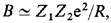
where M is the reduced mass. Introducing the approximate values of the universal constants


we find for a specific example of 18O+ 120Sn at E lab=100 MeV that L 60 units of ?

UNLIMITED FREE
ACCESS
TO THE WORLD'S BEST IDEAS

SUBMIT
Already a GlobalSpec user? Log in.

This is embarrasing...

An error occurred while processing the form. Please try again in a few minutes.

Customize Your GlobalSpec Experience

Category: Spectrometer Repair Services
Finish!
Privacy Policy

This is embarrasing...

An error occurred while processing the form. Please try again in a few minutes.