Mixed Analog-Digital Vlsi Devices and Technology
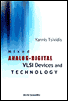
Filled with practical information, this reference book will help you grasp the nuances of mixed-signal VLSI-device models and layout that are crucial to the design of high-performance chips.
 TABLE OF CONTENTS
 Having discussed dc large-signal operation in the previous two chapters, we will now assume that the terminal voltages of a transistor vary around their "bias" values by small amounts. The resulting current variations will then also be small, and they can be expressed in terms of the voltage variations by using linear relations. We will discuss such linear relations and will develop linear circuits to represent them [ [1]]. Such circuits are called small-signal equivalent circuits; when eexcited by voltages equal to the small variations of the actual transistor voltages, these circuits will produce currents equal to the small variations of the actual transistor currents. Both conductance and capacitance parameters will be used as elements in these "models." We will assume that small-dimension effects are negligible, unless stated otherwise.
[1]Y. P. Tsividis, Operation and Modeling of the MOS Transistor, McGraw-Hill, New York, 1987.
Let us consider a MOS transistor biased with V GS, V SB, and V DS fixed at values V GSQ, V SBQ, and V DSQ, respectively, as shown in Fig. 4.1 a. Let I DQ be the resulting value of I D. We can study the effect of very small changes of the terminal voltages on I D by varying the voltages one at a time, as shown in Fig. 4.1b, c, and d. For now we are interested only in the change...