Mixed Analog-Digital Vlsi Devices and Technology

Filled with practical information, this reference book will help you grasp the nuances of mixed-signal VLSI-device models and layout that are crucial to the design of high-performance chips.
 TABLE OF CONTENTS
 As with any manufacturing process, a number of things can go wrong during chip production. The ratio of the number of packaged chips that function correctly to the total number of chips one started with on the wafers is called the final yield. This can vary widely (from 0 to nearly 100 percent) and is affected by defects on the wafer, problems during fabrication, unreliable wire bonds, improper handling, etc. Here we will concentrate on the intermediate yield at the end of the wafer fabrication process. This quantity is intimately related to chip size, as illustrated in Fig. 5.28. We assume for the sake of this example that in both cases shown in the figure the same defects (indicated by dots) occur at the same locations, and that one defect per chip is enough to render that chip nonfunctional. The defects are supposed to be due to fabrication, independent of the nature of the circuits on the chips. In Fig. 5.28a, where a small chip size is used, the yield is 87/94 ? 93 percent. In Fig. 5.28b, where the chip size is large, the yield is zero.
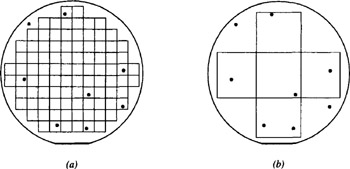
The above simple example illustrates why chips cannot be made too large in a given technology. Given that the fabrication cost per (good) chip equals...