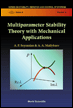
Multiparameter Stability Theory With Mechanical Applications, Series A, Volume 13
Concept of stability in common and engineering sense reflects necessity to keep response of a disturbed system within acceptable limits. If deviations describing response of the system from a given regime (e.g. state of equilibrium) lie within prescribed limits, the system is called stable. Otherwise, the system is called unstable. Disturbances, response, and prescribed limits can be specified in each case in different ways. In this book we mostly deal with dynamical problems for multiple degrees of freedom systems, and stability of motion is understood in the Liapunov sense.
Consider a dynamical system described by ordinary differential equations written in a vector form
| (1.1) | |
Here it is assumed that y=( y 1 , y 2, ..., y m) T is a real state vector, the dot over a symbol means differentiation with respect to time t, and f=( f 1, ..., f m) T is a real vector-function smoothly dependent on its variables providing existence and uniqueness of a solution with the initial condition y( t 0)= y 0 on the semi-infinite interval of time t ?t 0.
When the vector-function f does not depend on time explicitly, the system is called autonomous. Otherwise, the system is called non-autonomous or non-stationary.
Considering a partial solution
(t) of equation (1.1) as undisturbed motion and other solutions y (t) as disturbed motions, we observe evolution of...