2.3 Left Eigenvectors and Jordan Chains
Let us consider the eigenvalue problem for the transposed matrix
| (2.27) | 
|
Since
| (2.28) | 
|
the characteristic equations for the matrices A and A T coincide. The matrix A T has the same Jordan canonical form as the matrix A, see [Gantmacher (1998)]. Therefore, eigenvalues of the matrices A and A T are equal together with their algebraic, geometric, and partial multiplicities.
The eigenvalue problem for the matrix A T after the transposition takes the form
| (2.29) | 
|
where v is called the left eigenvector corresponding to the eigenvalue ?, in contrast to the eigenvector u called the right eigenvector.
If an eigenvalue ? is simple, then the left eigenvector is determined up to a nonzero scaling factor. Assuming that the right eigenvector u is given, we can define the left eigenvector of the simple eigenvalue uniquely by means of the normalization condition
| (2.30) | 
|
Notice that if u ? is a right eigenvector for an eigenvalue ? ?, and v is a left eigenvector for an eigenvalue ? ? ? ?, then [Gantmacher (1998)]
| (2.31) | 
|
Equations of the Jordan chain (2.4) for a nonderogatory eigenvalue ? of the matrix A T after transposition take the form
| (2.32) | 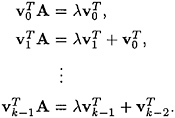
|
The vectors v 0, ..., v k ?1 are called the left Jordan chain for the eigenvalue ? as opposed to the right Jordan chain u 0


 TABLE OF CONTENTS