Multiparameter Stability Theory With Mechanical Applications, Series A, Volume 13
Let us assume that the matrix A smoothly depends on a vector of real parameters p=( p 1, ..., p n). The function A(p) is called a multi-parameter family of matrices. Eigenvalues of the matrix family are continuous functions of the parameter vector. In this section we study behavior of a simple eigenvalue of the matrix family A(p).
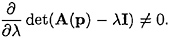
Let ? (p) be a simple eigenvalue of the matrix A(p). Since ? is a simple root of characteristic equation (2.2), we have
| (2.40) | |
Using inequality (2.40) and the implicit function theorem applied to characteristic equation (2.2), we find that the simple eigenvalue ? (p) of the matrix family A(p) smoothly depends on the parameter vector, and its derivatives with respect to parameters are equal to
| (2.41) | |
The eigenvector u(p) corresponding to ? (p) is determined up to a nonzero scaling factor. This eigenvector determines a one-dimensional null-subspace of the matrix operator A(p) ? ? (p)I smoothly dependent on p. Hence, the eigenvector u(p) can be chosen as a smooth function of the parameter vector.
Let us consider a point p 0 in the parameter space and assume that ? 0 is a simple eigenvalue of the matrix A 0 =A( p 0). Taking the derivative with respect to p i of both sides of eigenvalue problem (2.1), we find
| (2.42) | |
where u 0