Multiparameter Stability Theory With Mechanical Applications, Series A, Volume 13
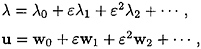
In this section we study multi-parameter behavior of two eigenvalues that merge and form a semi-simple double eigenvalue ? 0 at p 0. The eigenvalue ? 0 has two right eigenvectors u 1, u 2 and two left eigenvectors v 1, v 2 satisfying normalization conditions (2.161). Let us consider a perturbation of the parameter vector p=p 0 + ? p, where ? p= ? e with a direction e in the parameter space and a small perturbation parameter ?. By Theorem 2.6, the eigenvalue ? 0 and corresponding eigenvector u 0 take increments, which can be given in the form of expansions
| (2.177) | |
where
| (2.178) | |
and the coefficients ? 1, ? 2 are determined from the equation
| (2.179) | |
The coefficient ? 1 is an eigenvalue of the 2 2 matrix standing in the left-hand side. Two eigenvalues ? 1 of this matrix and the corresponding eigenvectors ( ? 1, ? 2) T determine leading terms in expansions (2.177) for two eigenvalues ? and corresponding eigenvectors u, which appear due to bifurcation of the double semi-simple eigenvalue ? 0.
Introducing the notation
| (2.180) | |
where X and Y are, respectively, the real and imaginary parts of the term ? ? 1, expansion for the eigenvalue (2.177) can be written in the form
| (2.181) | |
According to relations (2.73) and (2.179),