2.8 Bifurcation of Double Semi-Simple Eigenvalue
Let us consider the two-parameter matrix family
| (2.156) | 
|
Eigenvalues of the matrix A(p) are
| (2.157) | 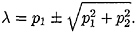
|
At p 0=0 the matrix A 0= A( p 0) has the semi-simple double zero eigenvalue. We see that eigenvalues (2.157) are not differentiate functions of the parameters at p 0. Nevertheless, leaving a single parameter, for example, setting p 2=0, we get two differentiate functions for the eigenvalues
| (2.158) | 
|
Thus, directional derivatives of the semi-simple eigenvalue exist.
Now let us consider an arbitrary family of matrices A(p). Let p 0 be a point in the parameter space, where the matrix A 0= A( p 0) has a semi-simple double eigenvalue ? 0. There are two linearly independent eigenvectors u 1 and u 2 satisfying the equations
| (2.159) | 
|
Two left eigenvectors satisfy the equations
| (2.160) | 
|
and can be uniquely determined for given u 1, u 2 by the normalization conditions
| (2.161) | 
|
Assuming perturbation of the parameter vector along curve (2.67), we can express perturbations of the eigenvalue ? 0 and corresponding eigenvectors in the form of power series [Vishik and Lyusternik (1960)]
| (2.162) | 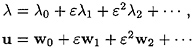
|
Notice that any linear combination of the eigenvectors u 1 and u 2 is also an eigenvector. This means that the zero order term w 0 in the expansion for the eigenvector u (the limit value of the eigenvector u as ? ?

 TABLE OF CONTENTS