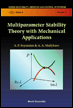
Multiparameter Stability Theory With Mechanical Applications, Series A, Volume 13
The theory of gyroscopic systems has a history which is more than one hundred years old. The possibility of stabilization of a statically unstable conservative system by gyroscopic forces is well known in mechanics for all kinds of rotating bodies such as tops, elastic shafts, satellites, space-crafts etc. We also notice that for some boundary conditions Coriolis forces appearing in elastic pipes conveying fluid are of gyroscopic nature.
We restrict ourselves to mentioning only a few of the numerous books and papers on this subject. One of the first important contributions in this field is [Thomson and Tait (1879)]. This topic has been also treated in the books [Chetayev (1961); Lancaster (1966); M ller (1977); Huseyin (1978); Merkin (1997)] and articles [Hagedorn (1975); Lakhadanov (1975); Barkwell and Lancaster (1992); Seyranian (1993b); Seyranian et al. (1995); Kliem and Seyranian (1997); Mailybaev and Seyranian (1999a); Seyranian and Kliem (2001)]. In this literature one can find more references.
In this chapter we study stability of linear gyroscopic systems, i.e., conservative systems with gyroscopic forces. We discuss general properties of gyroscopic systems and behavior of eigenvalues with a change of parameters. It is shown that strong interaction of eigenvalues is the mechanism of gyroscopic stabilization as well as loss of stability. As mechanical examples we consider stability problems for rotating shafts.
Let us consider a linear gyroscopic system
| (6.1) | |
where M and P are m m real symmetric mass and stiffness matrices with M