Silicon RF Power MOSFETS
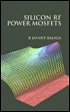
Providing general guidelines for understanding the design and operation of the transistors, this book describes the physics, design considerations and RF performance of silicon power MOSFETs.
 TABLE OF CONTENTS
 The focus of this book is on silicon power MOSFETs used for cellular signal amplification. These devices contain a channel region, which enables control of the output current of the transistor with an applied input voltage, and a drift region, which enables the transistor to operate at high voltages typical of base station power amplifier designs. In the case of silicon MOSFETs, the channel region is constructed by using a Metal-Oxide- Semiconductor (MOS) sandwich that allows modulation of the channel conductivity by the applied gate bias. The voltage controlled nature of the channel makes the biasing of power MOSFETs simpler than competing alternate technologies such as Hetero-junction Bipolar Transistors (HBTs).
The physics of operation of the basic Metal-Oxide-Semiconductor (MOS) sandwich has been treated in many textbooks [1] , [2] , [3]. In the interest of space, this treatment will not be repeated here and readers should look to the references for this material. However, the basic theory underlying channel conduction will be reviewed to enable contrasting the well-know channel pinch-off based operation of MOSFETs to the new super-linear characteristics described for the first time in this book. In addition, the various components of the resistance within the power MOSFET structure will be reviewed because they determine the lowest voltage to which the transistor can operate with the RF signals, thus limiting the output power and the efficiency. Since many of the new super-linear MOSFET structures described in subsequent chapters utilize the charge coupling concept to reduce the on-resistance,...