Silicon RF Power MOSFETS
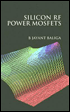
Providing general guidelines for understanding the design and operation of the transistors, this book describes the physics, design considerations and RF performance of silicon power MOSFETs.
 TABLE OF CONTENTS
 In this section, the basic physics of operation of the power MOSFET will be described with the aid of the vertical DMOS structure. The same concepts are applicable to the Lateral MOSFET structure as well. A cross-section of the basic Double-diffused or DMOS structure is illustrated in Fig. 3.1. In addition to the Metal-Oxide-Semiconductor structure formed under the gate region, this structure contains a lighted doped N- drift region that enables supporting high voltages.

With the gate shorted to the source terminal by an external bias circuit, the doping concentration of the P-base region is designed so that no channel is formed at the surface. Under these conditions, the drain voltage is supported across the P-base/N-drift region junction. The doping concentration and thickness of the N-drift region must be chosen so that the breakdown voltage of the transistor cell shown in the figure exceeds the desired operating voltage in the application. For a typical cellular base station power amplifier application, the DC supply voltage is nominally at 30V (varies from 28 32 V) with the RF signal superimposed on this DC bias. The transistor must sustain up to 60 V without under-going breakdown. With design margins and accounting for electric field enhancement at the edge termination [3], the transistor cell must be designed to support about 80 V.
The design rules for determination of the doping concentration and thickness of the drift region for obtaining a desired breakdown...