Silicon RF Power MOSFETS
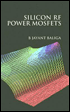
Providing general guidelines for understanding the design and operation of the transistors, this book describes the physics, design considerations and RF performance of silicon power MOSFETs.
 TABLE OF CONTENTS
 The commercial introduction of the silicon RF power LD-MOSFETs in the 1990's was widely accepted by the cellular base station design community due to its superior linearity when compared with the existing silicon bipolar RF power transistors, as well as its lower cost when compared with existing gallium arsenide RF power transistors. However, these devices were found to exhibit instability in the quiescent operating point. It was discovered that the quiescent drain current at the chosen operating DC gate bias voltage changed by more than 20 percent over the operating life of the product. Due to the exponential nature of this variation, the instability was manifested by a large change in drain current at the early stages of the operating life of products. The changes in the quiescent drain current had significant adverse impact on the linearity of the transistor because the quiescent drain current is optimized for delivering the best combination of linearity and efficiency in RF Power Amplifiers.
One approach taken to address this instability was to burn-in the products prior to installation in power amplifiers. Although somewhat effective, this approach adds significant cost to the production of RF LD-MOSFETs because the burn-in must be done with each transistor biased under optimum conditions. Another approach taken was to add additional circuitry in the RF amplifier too monitor and adjust the quiescent drain current. This approach also adds considerable expense because the circuitry must be able to take into account changes in ambient temperature. Meanwhile, improvements to the...