Silicon RF Power MOSFETS
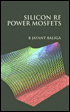
Providing general guidelines for understanding the design and operation of the transistors, this book describes the physics, design considerations and RF performance of silicon power MOSFETs.
 TABLE OF CONTENTS
 Until the mid-1990s, the cellular RF power amplification applications were based upon utilizing either silicon bipolar transistors or gallium arsenide MESFETs. The introduction of the high voltage lateral-diffused (LD) MOSFET in the latter part of the 1990s altered the market dynamics. Articles written in this timeframe [1] describe the LD-MOSFET as a novel technology that is starting to challenge the entrenched position of the silicon bipolar transistor because of reduced distortion, while being more competitive than the gallium arsenide devices due to significantly lower cost. However, significant concerns regarding the ruggedness and reliability of the LD-MOSFETs were prevalent in the industry.
Within a few years [2], the LD-MOSFETs had successfully displaced the silicon bipolar transistors and shut out the gallium arsenide devices from the cellular base-station market. Improvements in its efficiency and linearity provided significant cost-performance benefits to the end user. In addition, these devices could be operated using a single 28-V supply. However, the drift of the threshold voltage of the transistor during operation at the quiescent operating point continued to haunt the technology. In spite of several generations of technology improvements, the manufacturers could only guarantee a change of less than 10 percent over a 20 year time span in spite of using burn-in to stabilize the devices. The drift in threshold voltage, arising from an injection of hot-electrons into the gate oxide, created a major problem in obtaining stable performance. Fortunately, further structural and process enhancements during the last few years have brought the...