Superconductivity, Revised Edition

Chapter 1: The Discovery of Superconductivity

The Beginning

In 1911 a Dutch physicist, H.Kamerlingh-Onnes, discovered the phenomenon of superconductivity. He measured the electric resistance of mercury at very low temperatures. Onnes wanted to know how small the resistance to an electric current can become if a substance is purified and the temperature (thermal noise) is lowered as much as possible.

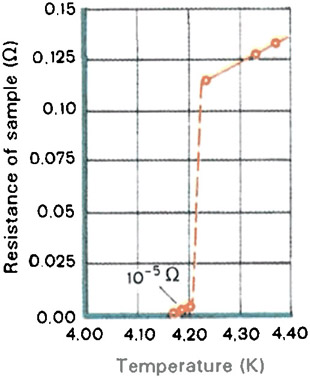
The result of this investigation was unexpected: at a temperature below 4.15 K, [a] the resistance disappeared almost instantaneously. The behavior of resistance as a function of temperature is shown schematically in Fig. 1.


Fig. 1: Data from one of Onnes pioneering works devoted to superconductivity. According to current data, the curve should now be shifted by 0.05 K, since the temperature scale used by Onnes was inaccurate.

An electric current is the motion of charged particles. At that time it was already known that electric current in a solid is a flux of electrons. Electrons are negatively charged and are much lighter than the atoms that make up any substance.

Each atom, in turn, consists of a positively charged nucleus and electrons which interact with the nucleus and among themselves in accordance with Coulomb s law. Each atomic electron occupies a certain orbit. The nearer the orbit is to the nucleus, the stronger the electron is attracted by it and therefore the greater is the energy needed to detach such an electron from the nucleus. The outermost electrons are, in contrast, readily detachable, although some energy is needed for this process too.

UNLIMITED FREE
ACCESS
TO THE WORLD'S BEST IDEAS

SUBMIT
Already a GlobalSpec user? Log in.

This is embarrasing...

An error occurred while processing the form. Please try again in a few minutes.

Customize Your GlobalSpec Experience

Category: Superconductors and Superconducting Materials
Finish!
Privacy Policy

This is embarrasing...

An error occurred while processing the form. Please try again in a few minutes.