Superconductivity, Revised Edition

The Intermediate State

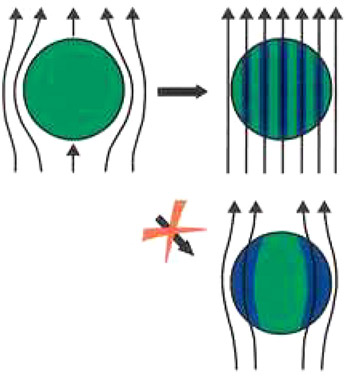
Now let us imagine a superconducting ball immersed in a weak magnetic field (see Fig. 16). In a near-boundary layer of thickness ? L, screening currents will appear along the surface of the ball, which will force out the magnetic field. Let the diameter of this ball be much larger than ? L, therefore the thin boundary layer is not indicated in the figure. We assume the magnetic field to be completely forced out of the ball. But than the magnetic field becomes nonuniform in different places near the ball surface. Its magnitude near the poles is smaller, while near the equator , it is greater.


Fig. 16: A superconducting ball in a magnetic field. A weak magnetic field is completely expelled from the ball. In a sufficiently strong magnetic field, an intermediate state of the ball occurs. The normal regions are traversed by magnetic field lines. The regions where superconductivity is preserved are shown in green.

We now strengthen the magnetic field to see what will happen near the equator when it reaches the critical value. Such a field must destroy superconductivity in the vicinity of the ball and penetrate inside. At first glance it seems that the situation reached must be as shown in the figure, where the magnetic field has penetrated the equatorial regions and transformed them into the normal state. But given this, the magnitude of the field itself decreases. Imagine again the magnetic field lines as a flow of liquid.

UNLIMITED FREE
ACCESS
TO THE WORLD'S BEST IDEAS

SUBMIT
Already a GlobalSpec user? Log in.

This is embarrasing...

An error occurred while processing the form. Please try again in a few minutes.

Customize Your GlobalSpec Experience

Category: Superconductors and Superconducting Materials
Finish!
Privacy Policy

This is embarrasing...

An error occurred while processing the form. Please try again in a few minutes.