Superconductivity, Revised Edition

Phase Transition

It is well known to physicists that the resistance of a type I superconductor to a constant electric current is equal to zero, and we hope you believe it too. This means that a superconductor differs essentially from the best normal conductor with a very low resistance. These are two distinct states of a substance. In physics, this is described as follows. A metal can exist in a normal state (at a temperature above T c) and in a superconducting state (at a temperature below T c). Both these states are called phases. This special term is meant to emphasize that the substance is in equilibrium, which is a very important physical concept.

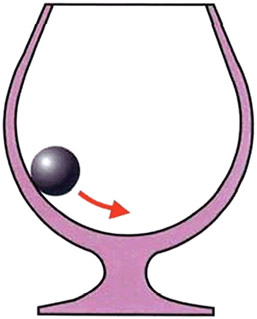
The simplest illustration of such an equilibrium state is a small steel ball rolling about in a wineglass (see Fig. 8). Due to friction, it will finally stop at the bottom of the wineglass. The ball will be in equilibrium irrespective of the point from which it starts to roll. The state in which the ball has the lowest energy is the equilibrium state.


Fig. 8: A small steel ball rolling about in a wineglass illustrating the attainment of an equilibrium state.

Now imagine that the ball in the wineglass is in some way akin to a metallic sample. If we cool it down, then at each temperature it has an equilibrium energy. The two curves in Fig. 9 represent the temperature dependences of the equilibrium energy for the normal and...

UNLIMITED FREE
ACCESS
TO THE WORLD'S BEST IDEAS

SUBMIT
Already a GlobalSpec user? Log in.

This is embarrasing...

An error occurred while processing the form. Please try again in a few minutes.

Customize Your GlobalSpec Experience

Category: Superconductors and Superconducting Materials
Finish!
Privacy Policy

This is embarrasing...

An error occurred while processing the form. Please try again in a few minutes.