Superconductivity, Revised Edition

This is a very beautiful and quite unusual phenomenon, the reason being that few believed in the existence of vortices until they were discovered experimentally.
In a type II superconductor, vortices are oriented parallel to the external magnetic field. They appear as soon as the field is switched on and can go in or out of the sample only through a side surface . Vortices can be likened to cheese holes, and through these holes the magnetic field penetrates into the bulk superconductor.
We can say provisionally that each vortex captures and takes inside the superconductor a single magnetic field line. An increase in the strength of the external magnetic field affects neither the dimension of each vortex nor the magnitude of the magnetic field flux transmitted by it. Simply, the number of vortices increases and the distance between them becomes smaller.
Vortices are not indifferent to one another. The currents flowing in them interfere, and therefore parallel vortices repel. They try to keep apart, but when there are many of them, repulsion occurs from all sides.
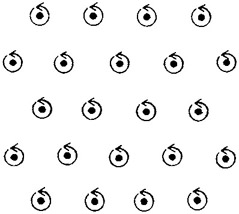
Like atoms in a crystal, vortices typically form a regular lattice. If we look in the direction of the magnetic field, so to speak, from the end face of the cylinder vortices, we usually see a triangular lattice as shown schematically in Fig. 19. This picture was experimentally observed in approximately the same way as an intermediate state of type I superconductors, but of course under a microscope.