Superconductivity, Revised Edition

In describing the phase transition to a superconducting state, we said that it requires no energy expenditure since it represents only a variation in the pattern of electron motion.
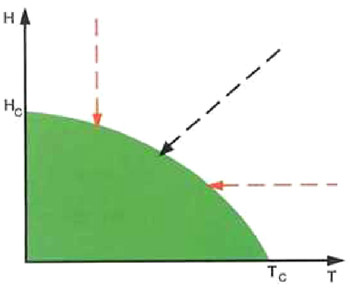
This is, however, not the case if the magnetic field is not equal to zero. If a sample is in a magnetic field, the transition requires energy expenditure to expel the magnetic field from the sample. This process takes up as much energy as that stored by the magnetic field in the bulk metal. Experiments show that the possibilities of a superconductor are limited in this respect. If the magnetic field exceeds a certain value, it cannot be expelled in the course of the metal cooling, and superconductivity does not occur. Such a magnetic field is called a critical magnetic field for a given material and is denoted by H c. The temperature dependence of H c is most frequently of the form shown in Fig. 12. The dependence is given by the line separating the green and white portions of the graph.
To obtain a superconducting state, we have to get into the green region. This can be done either by diminishing the magnetic field at a constant temperature T until a critical value