Superconductivity, Revised Edition

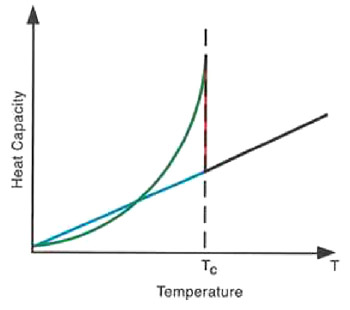
In a superconducting phase transition, the electric resistance changes with a jump, while the energy undergoes a continuous variation. One of the most important thermal characteristics of a substance, namely, the specific heat, or the amount of heat necessary to affect its temperature, also changes with a jump. There is a simple rule. In order that 1 g of water can be heated by 1 C at room temperature, 1 calorie of heat is needed (1 calorie is a little more than 4 J; one Joule (J) is the work done by a force of 1 Newton for a distance of 1 m). This rule means that the specific heat of water at room temperature is equal to unity. When a substance is cooled, its specific heat typically decreases; at the moment of a superconducting transition, however, it increases in a jump by approximately a factor of 2.5 3 (see Fig. 10).
For comparison, the heat capacities of several substances at room temperature are given in Table 4.
| Substance | Heat Capacity | |
|---|---|---|
| (J/kg K) | (cal/g K) | |
| Water | 4.19 10 ?3 | 1 |
| Acetone | 2.18 10 ?3 | 0.52 |
| Aluminium | 0.9 10 ?3 | 0.216 |
| Iron | 0.46 10 ?3 | 0.11 |
| Mercury | 0.14 10 ?3 | 0.033 |
| Lead | 0.13 10 ?3 | 0.031 |