Most problems in stress analysis are described by differential equations. Sometimes these can be solved analytically with little effort. More often, however, the geometry of the part to be analyzed, its material properties, and so on, introduce considerable complications, thus making an analytical solution impossible to obtain. In such situations numerical methods play a very important role. In this chapter we develop basic ideas for the methods of finite differences, iteration, and collocation. The numerical method of finite elements is treated separately in Chapter 7. In this chapter, for comparison purposes, we solve one simple example using various methods. Applications to stress analysis can be found in other chapters of this text.
6-1 METHOD OF FINITE DIFFERENCES
The goal of the finite differences method is the replacement of the differential equation by a system of algebraic equations. This is achieved by replacing the derivatives by the so-called difference quotients.
6-1-1 Application to Ordinary Differential Equations
We begin by solving an ordinary differential equation for the unknown y( x), where a ? x ? b. First we divide the interval a, b into n equal [*] parts, as shown in Fig. 6-1,
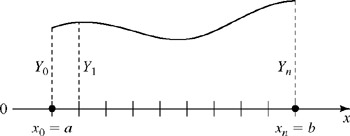 Figure 6-1
 Next the endpoints of the subintervals thus obtained are labeled
Points x i are called pivotal points ( pivots for short), and h is called a pivotal interval. Finally the approximate values of the unknown function y( x) at x = x i
Copyright Oxford University Press, Inc. 2003 under license agreement with Books24x7


 TABLE OF CONTENTS