Advanced Mechanics of Materials

Stability and vibration are important components of structural and machine design. Since they are related physically (vibration ceases when the buckling stage is attained) and also mathematically, we discuss them together in this chapter. We deal specifically with the elastic stability and vibration of two-dimensional structures (beams, rings, arches) and three-dimensional structures (rectangular plates).
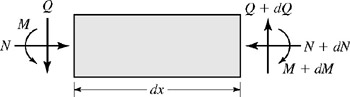
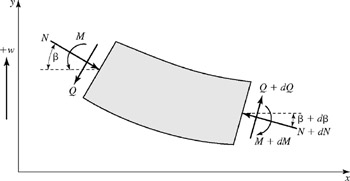
Consider an element of a laterally vibrating beam subjected at the ends to time-independent, self-equilibrating axial forces P. We will see that the presence of such forces influences the frequencies of vibration. We will also prove that when a compressive force reaches the critical value, vibration ceases completely and buckling occurs. To begin let us derive the differential equation describing this problem. [*] To this end we analyze the element of Fig. 11-1 shown in the deformed configuration in Fig. 11-2, [ ] where M = M( x, t), N = N( x, t), and V = V( x, t) are the bending moment, the axial force, and the shear force, respectively. The projection of all forces on the Ox axis gives
Since ? ? 1, then sin ? ? ? and cos ? ? 1. Thus Eq. (11-1) becomes
But since V is usually much smaller than N [1, 8], the last two...