Advanced Mechanics of Materials

8-8: LIMIT ANALYSIS [19, pp. 300-326]

8-8 LIMIT ANALYSIS [19, pp. 300-326]

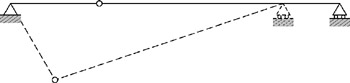
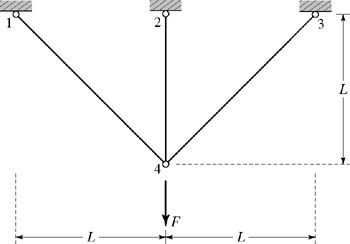
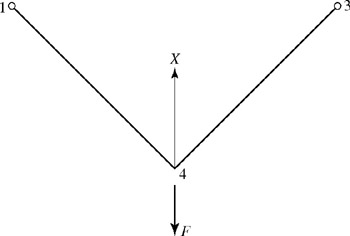
So far we only analyzed elastic beams. When a beam, or another structure composed of thin rods, reaches yield stress at some cross section, then this section behaves like a hinge. Thus the beam transforms into a mechanism whose parts can rotate around this hinge, causing the collapse of the system (Fig. 8-75). However, when a statically indeterminate beam, made of a ductile material, reaches yield stress at a certain cross section, it may still carry loads. This is studied by the theory of limit analysis based on the theory of plasticity. A few examples will help in understanding this theory. Let us consider the three-bar symmetric truss shown in Fig. 8-76. It is assumed that each bar has the same cross-sectional area A and is made of the same material with Young's modulus E in the elastic range. First we calculate the forces and the deformations of each bar. We note that the truss is statically indeterminate and we remove bar 2-4, replacing its action by the unknown force X (Fig. 8-77). From the equilibrium equation of node 4 we find that the force N in each remaining bar is


Figure 8-75: Collapse of beam with plastic hinge

Figure 8-76

Figure 8-77

In order to determine X we use the conditional equation

which states that the vertical displacement of the system 1-4-3 at node 4 equals the extension of the removed bar 2-4. However,

whereas

where the...

UNLIMITED FREE
ACCESS
TO THE WORLD'S BEST IDEAS

SUBMIT
Already a GlobalSpec user? Log in.

This is embarrasing...

An error occurred while processing the form. Please try again in a few minutes.

Customize Your GlobalSpec Experience

Category: Flip-Flops
Finish!
Privacy Policy

This is embarrasing...

An error occurred while processing the form. Please try again in a few minutes.