Let us consider a vector A connecting two points in space, O and P. We establish a right-handed orthogonal coordinate system x, y, z with origin at point O and unit vectors i, j, and k directed along the x, y, and z axes, respectively, as shown in Fig. B-1. We can write A in terms of its components A x, A y, A z and the unit vectors as
 Figure B-1
 A can, of course, be described just as easily in another right-handed orthogonal coordinate system, say, the x ?, y ?, z ? coordinate system shown in Fig. B-2 whose unit vectors in the x ?, y ?, and z ? coordinate directions are i ?, j ?, and k ?, respectively. In terms of its components A x, A y, and A z, the vector A is given by
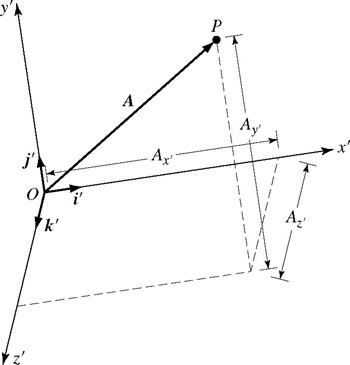 Figure B-2
 Supposing that the components of A are known in the x, y, z coordinate system and that the relationship between the primed and unprimed coordinate systems is known, the components of A in the primed coordinate system can be found.
To begin with, note that A x ? is simply the projection of A on the x ? axis. Thus with the nomenclature of Fig. B-3,
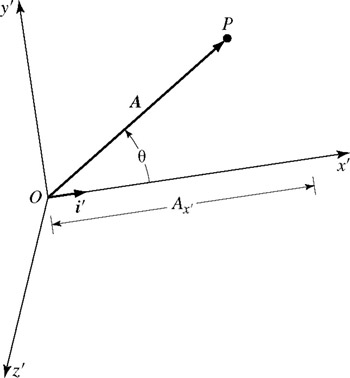 Figure B-3
 where A is...
Copyright Oxford University Press, Inc. 2003 under license agreement with Books24x7


 TABLE OF CONTENTS