Advanced Mechanics of Materials

8-7: COMPOSITE BEAMS

8-7 COMPOSITE BEAMS

We consider in this section the bending of thin straight beams composed of several layers made from different orthotropic materials. We derive a differential equation analogous to that of homogeneous beams and solve some problems.

8-7-1 Stresses, Bending Moments, and Bending Stiffness of a Laminated Beam

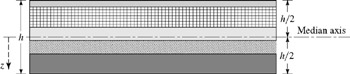
A beam composed of N perfectly bonded layers of various orthotropic materials is shown in Fig. 8-72. Such a beam is known as a laminated beam. The usual assumptions of the thin beam theory are also valid here:

  1. The plane cross sections, initially perpendicular to the axis of the beam, remain plane and perpendicular after deformation.

  2. All stresses are functions only of x and z.

  3. The total thickness h of the beam is small compared to the span length.

  4. The normal stress ? zz is zero.

  5. The strains ? xz and ? yz are zero.


Figure 8-72: Laminated beam

As a result of assumption 1 the strains are linear functions of the distance z from the still unknown neutral axis,

where y = y( x) is the deflection. Let us consider a three-layer beam (Fig. 8-73) as an example. The resulting expressions will be generalized easily to be valid for a beam with an arbitrary number of layers. Although the strain is continuous across the interfaces, the stress is not. This is due to the assumed validity of Hooke's law and to the differences in the Young's moduli for...

UNLIMITED FREE
ACCESS
TO THE WORLD'S BEST IDEAS

SUBMIT
Already a GlobalSpec user? Log in.

This is embarrasing...

An error occurred while processing the form. Please try again in a few minutes.

Customize Your GlobalSpec Experience

Category: Calcite Polarizers
Finish!
Privacy Policy

This is embarrasing...

An error occurred while processing the form. Please try again in a few minutes.