Advanced Mechanics of Materials

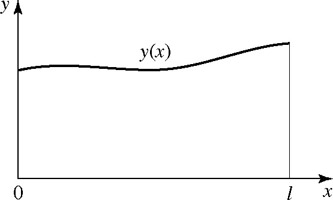
Fourier series not only constitute an important class of trial functions for application with the Rayleigh-Ritz method (see Section 8-10), but it can also be used directly to solve the differential equation for the deflection of a beam. Consider an arbitrary function y( x) (Fig. 8-83). Assuming that it does not tend to infinity for 0 ? x ? l, we represent it as an infinite series,
or, alternatively, as
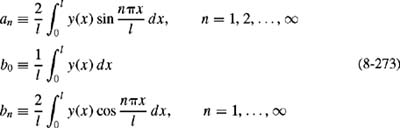
called Fourier sine series and Fourier cosine series, respectively. The coefficients

are called Fourier coefficients of the function y( x). It can be shown [26, pp. 75ff.] that the Fourier series of y( x) converges to y( x). This means that if we were able to represent the sum of the infinite series in closed form, then the result would equal exactly y( x). When such a representation is impossible, then the convergence guarantees that increasing the number of terms taken into account increases the accuracy of the result. It is also crucial to note that sine and cosine series can be obtained for the same function. One of the important features of the sets of functions sin n ? x/ l and cos n ? x/ l is their orthogonality, which means that

We begin with an example concerning the bending of a simply supported beam.
Find the deflection y(