Airborne Early Radar Warning System Concepts

Chapter 4: Radar Basics

H. A. Corriher, Jr. Consultant
Atlanta, Georgia

4.1 INTRODUCTION

Originally, the term "radar" was an acronym derived from the phrase "radio detection and ranging." It was first used as a code word by the U.S. Navy in 1940. Other early names included the British RDF (for "radio direction finding") and the German Funkmessger t. Radar has now become standard in international usage, although the Soviets commonly use RLS, an abbreviation of the Russian words for "radiolocation station."

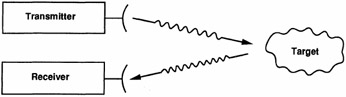
In its simplest terms, a radar is a device for detecting and locating objects (targets) of interest. The basic principle of operation involves the transmission of electromagnetic waves and, some time later, the reception of the waves reflected from the target (the echo) as illustrated in Figure 4.1. Many references on both principles and details of radar are available (for example, [1 15]). Each of these references emphasizes different aspects of radar fundamentals, types, and applications, particularly with respect to what was "new" at the time of writing. Two additional books [16, 17] may be mentioned on the basis that they concentrate on radar performance, although they also deal with other topics related to this broad area.


Figure 4.1: The basic echo principle of radar ( monostatic if transmitting and receiving antennas are collocated, bistatic if separated).

As used above, the term "target" generally designates an object of interest to the radar user in a given situation. In addition to the inescapable "noise" present in all radio...

UNLIMITED FREE
ACCESS
TO THE WORLD'S BEST IDEAS

SUBMIT
Already a GlobalSpec user? Log in.

This is embarrasing...

An error occurred while processing the form. Please try again in a few minutes.

Customize Your GlobalSpec Experience

Category: Radar Systems and Products
Finish!
Privacy Policy

This is embarrasing...

An error occurred while processing the form. Please try again in a few minutes.