Airborne Early Radar Warning System Concepts

Chapter 11: Aerostat Radar Systems

Lawrence E. Mertens Suntech, Inc. Melbourne, Florida

11.1 INTRODUCTION

Aerodynamically shaped, tethered balloons, commonly referred to as aerostats, provide high-endurance and cost-effective platforms for many airborne early warning applications. This chapter describes modern aerostats and support systems, their advantages and problems, and the radar sensors used on board.

11.2 HISTORY

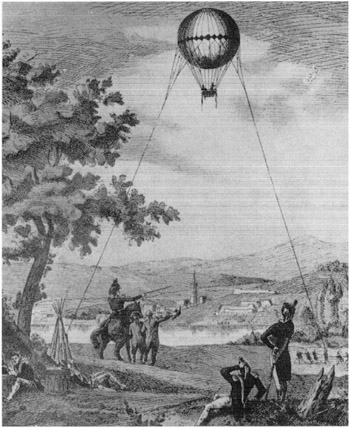
Earliest records of the use of tethered balloons can be traced to the Chinese Ming Dynasty (1368 1644). In Europe, the first successful balloons were built and flown by the Montgolfier brothers in 1783 using a large paper bag inflated with hot air. The first manned tethered balloon flight was made in Paris a few months later by Pilatre de Rozier. Almost immediately, the potential military advantages of the elevated position provided by the balloon were realized. A balloon school and balloon corps were founded in France in the following decade. Figure 11.1 depicts an early French tethered balloon.


Figure 11.1: Double tethered Balloon, early French, 1795 (from Myers [1]).

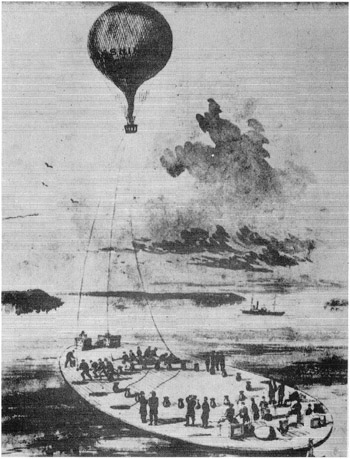
There was little use of military balloons in the 19th century until the outbreak of the American Civil War. Both sides employed tethered balloons for aerial observation with some success. A measure of mobility was gained by attaching the balloons to locomotives and steamboats. The first boat for balloon operations, built by G.W. Parke Custis in 1861, is illustrated in Figure 11.2.


Figure 11.2: Lowe's balloon Washington aboard the Custis during American Civil War, 1861 (from Myers [1]).

By the end of the 19th century the Germans experimented with...

UNLIMITED FREE
ACCESS
TO THE WORLD'S BEST IDEAS

SUBMIT
Already a GlobalSpec user? Log in.

This is embarrasing...

An error occurred while processing the form. Please try again in a few minutes.

Customize Your GlobalSpec Experience

Category: Aircraft
Finish!
Privacy Policy

This is embarrasing...

An error occurred while processing the form. Please try again in a few minutes.