Airborne Early Radar Warning System Concepts

Maurice W. Long
Private Consultant
Atlanta, Georgia
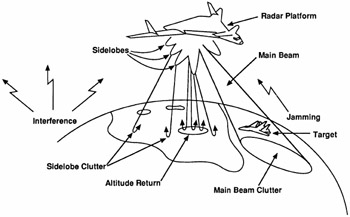
The purpose of Chapter 6 is to address the capabilities and needs of airborne early warning (AEW) radar. Figure 6.1, derived from Toomay [1], helps to depict the environment of airborne radars, namely:
radar-earth-target geometry, with its associated problems of atmospheric refraction, attenuation, and multipath effects
relative aircraft-earth-target velocities, with the associated Doppler-processing challenges
restrictions on frontal area and weight that limit antennas to relatively small sizes, which thereby contribute to poor angular resolution and increased Doppler spreading
complex aircraft/antenna geometry, which contributes to larger antenna side-lobes and distortion of the main lobe
jamming and other electromagnetic interference.
AEW radars use two basic modes of operation: (1) the Doppler mode to detect moving aircraft over land and sea, and (2) the ordinary pulse or non-Doppler mode for detecting stationary or slow-moving targets such as boats or ships. The long-range Doppler detection mode, with its requirements made stringent by operating from a moving platform, distinguishes the AEW radar from others.
Principal problems associated with detection at long range of moving, low radar cross section (RCS) targets include:
target echo level relative to receiver noise
target echo level with respect to average background clutter caused by surface echo (land and water)
the processing and subsequent elimination of false targets generated by strong stationary targets such as buildings, cliffs, water towers
the processing and subsequent elimination of unwanted moving nuisance targets such as automobiles, birds, boats