Airborne Early Radar Warning System Concepts

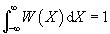
Probability (Pr) is the expected fractional frequency of occurrence of a statistical event, and thereby probability is always positive and never exceeds unity. For example, assume that the probability that a variable X lies between X 1 and X 2 is 0.2. Then, Pr{ X 1 ? X ? X 2} = 0.2 and Pr{ X is any value} = { ? ? X ? - ?} = 1. The probability density function W( X) is defined so that W( X) = Pr{ X is between X and X + dX}. Then,
| (A.1) | |
and
| (A.2) | |
The mean or, equivalently, the average of a variable X is denoted by an overbar or brackets as X or ? X ? and can be obtained through use of W( X) as follows:
| (A.3) | |
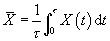
If X is a time-dependent function, a time average or running average over a time interval ? can, of course, be obtained as follows:
| (A.4) | |
The variance S 2 is a mathematical quantity used to provide a feeling for the range of fluctuations from the average or mean. Specifically, S 2 is the average of the deviations (from the mean) squared and can be expressed as
| (A.5) | |
The standard deviation S is another mathematical quantity used to express deviation from the mean and is expressed as
An advantage of using