Airborne Early Radar Warning System Concepts

6.3: SELECTED SUBSYSTEMS

6.3 SELECTED SUBSYSTEMS

The major components or subsystems of pulse radar are introduced in Chapter 4. Section 6.3 addresses selected features of the subsystems to which AEW performance is considered especially critical.

6.3.1 Antennas and Active Phased Arrays

AEW radars differ in their antenna types, as well as in radar frequency and transmit waveform. This section briefly addresses antennas and antenna performance needs for AEW.

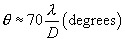
Approximate relationships for antenna beamwidths and gain are introduced in Section 4.2, and more definitive information as a function of aperture illumination is included in Section 8.2. The 3-dB beamwidth ? in terms of antenna linear dimension D within the plane of a pattern is approximately

(6.23)

where wavelength ? and D are in the same units. Furthermore, if ? a and ? e are the 3-dB azimuth and elevation beamwidths in degrees, respectively, the peak gain G for a relatively lossless antenna is approximately

(6.24)

An example for an L-band antenna of frequency 1200 MHz ( ? = 25 cm) follows. Let the antenna width and height be 10 meters by 2 meters, respectively. Then, the 3-dB beamwidths ? a and ? e are approximately 1.75 and 8.75 , respectively. Also, antenna gain G is then 1959 which, in decibels (10 log 10 G), equals 32.9 dB.

The general physical requirements for AEW antennas can be deducted from (6.21) and (6.24) and are as follows:

  • Long-range target detection dictates the need for a...

UNLIMITED FREE
ACCESS
TO THE WORLD'S BEST IDEAS

SUBMIT
Already a GlobalSpec user? Log in.

This is embarrasing...

An error occurred while processing the form. Please try again in a few minutes.

Customize Your GlobalSpec Experience

Category: Horn Antennas
Finish!
Privacy Policy

This is embarrasing...

An error occurred while processing the form. Please try again in a few minutes.