Airborne Early Radar Warning System Concepts

There are a number of technical issues that tend to be especially difficult or unique to airborne MTI (AMTI) or airborne pulse-doppler radar. For example, the problems of range and Doppler ambiguities, as well as Doppler filtering, are more difficult on aircraft. The reasons include: (1) a heightened platform permits greater detection ranges and generally larger depression angles, and (2) the platform ground speed with respect to the earth modulates the clutter and introduces, for example, a sidelobe clutter spectrum width that corresponds to the Doppler frequency for twice the platform speed. This section discusses range and Doppler ambiguities plus their removal, airborne Doppler clutter spectra and effects of processing, and the advantages and limitations of the three classic PRF modes (low, medium, high) used for Doppler radar.
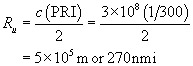
The pulse repetition frequency (PRF) or PRI (1/PRF) determines the maximum unambiguous range that can be obtained when transmitting periodic pulses. For example, since the velocity of propagation c is approximately 3 10 8 m/s, a pulse will travel a distance of c times the PRI, or a round-trip distance of c(PRI)/2 during an interpulse period. Then, the maximum unambiguous range R u for a 300-Hz PRF is
| (6.25) | |
Similarly, if the PRF were 3 kHz or 30 kHz, the unambiguous range would be 27 nmi or 2.7 nmi, respectively. Therefore, without some type of label, it is impossible to know the range to...