Biomechanics: Concepts and Computation

Using a quantitative biomechanics approach, this book integrates both general and specific topics, theoretical background and biomedical engineering applications, as well as analytical and numerical approaches.
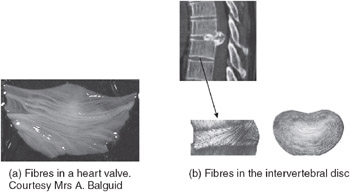
Fibres and fibre-like structures play an important role in the mechanical properties of biological tissues. Fibre-like structures may be found in almost all human tissues. A typical example is the fibre reinforcement in a heart valve, Fig. 4.1(a). Another illustration is found in the intervertebral disc as shown in Fig. 4.1(b).
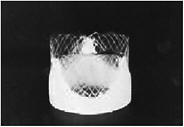
Fibre reinforcement, largely inspired by nature, is frequently used in prosthesis design to optimize mechanical performance. An example is found in the aortic valve prosthesis, see Fig. 4.2.
Fibres are long slender bodies and, essentially, have a tensile load bearing capacity along the fibre direction only. The most simple approximation of the, often complicated, mechanical behaviour of fibres is to assume that they behave elastically. In that case fibres have much in common with springs. The objective of this chapter is to formulate a relation between the force in the fibre and the change in length of a fibre. Such a relation is called a constitutive model.
Assume, for the time being, that the fibre is represented by a simple spring as sketched in Fig. 4.3. At the left end the spring is attached to the wall while the right end is loaded with a certain force F. If no load is applied to the spring (fibre) the length of the spring equals ? 0, called the reference or initial length. After...

 TABLE OF CONTENTS