Biomechanics: Concepts and Computation

Using a quantitative biomechanics approach, this book integrates both general and specific topics, theoretical background and biomedical engineering applications, as well as analytical and numerical approaches.
In the previous chapters the global behaviour of fibres was considered, without much attention to the detailed shape of these structures. Only the length change of the fibre played a role in the analysis. In the present chapter we address in a little bit more detail the deformation of long slender structures. These can be tendons, muscles, but also long bones. The aim is, to generalize the concepts introduced in previous chapters for discrete systems (i.e. springs) to continuous systems. To simplify matters the loading and deformation of a one-dimensional elastic bar is considered.
Consider a straight bar as visualized in Fig. 6.1(a), loaded by an external force F at x = L and fixed in space at x = 0. The figure shows the bar with the x-axis in the longitudinal or axial direction. It is assumed, that each cross section initially perpendicular to the axis of the bar remains perpendicular to the axis after loading. In fact it is assumed that all properties and displacements are a function of the x-coordinate only.
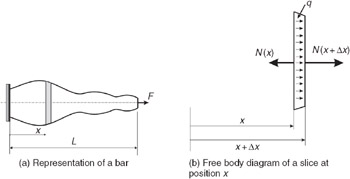
The objective is, to compute the displacement of each cross section of the bar due to the loading. The area of the cross section perpendicular to the central axis of the bar as well as the mechanical properties of the bar may be a function of...

 TABLE OF CONTENTS