Biomechanics: Concepts and Computation

Using a quantitative biomechanics approach, this book integrates both general and specific topics, theoretical background and biomedical engineering applications, as well as analytical and numerical approaches.
Consider the geometrical change of a coherent amount of material or material fraction, for which modelling as a continuum is assumed to be permitted. The first part of the present chapter is focussed on the description of the local deformation (generally coupled with rotations of the material) and along with that, the introduction of a number of different strain measures.
Only after choosing a reference configuration is it possible to define deformation in a meaningful way (deformation is a relative concept). This implies that initially the theory and the accompanying application area are related to solids. When the material is a mixture of several material fractions, each fraction can, with regard to local geometrical changes, in principle, be isolated from the other fractions.
The second part of this chapter discusses geometrical changes in time. Central concepts in this part are deformation rate and rotation velocity (spin). The derivations in this part are not only relevant for solids, but even more important for applications including fluids.
Consider a coherent amount of material in a fully defined state (the reference configuration). In a material point P, with position vector  in the reference configuration, we focus our attention on an arbitrary infinitesimally small material line segment
  , see Fig. 10.1.
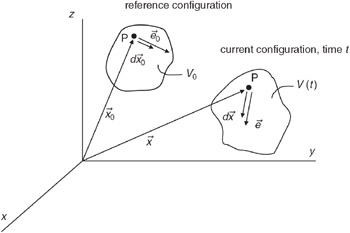
With respect to the Cartesian xyz-coordinate system the vector can be written as

The orientation of...

 TABLE OF CONTENTS